
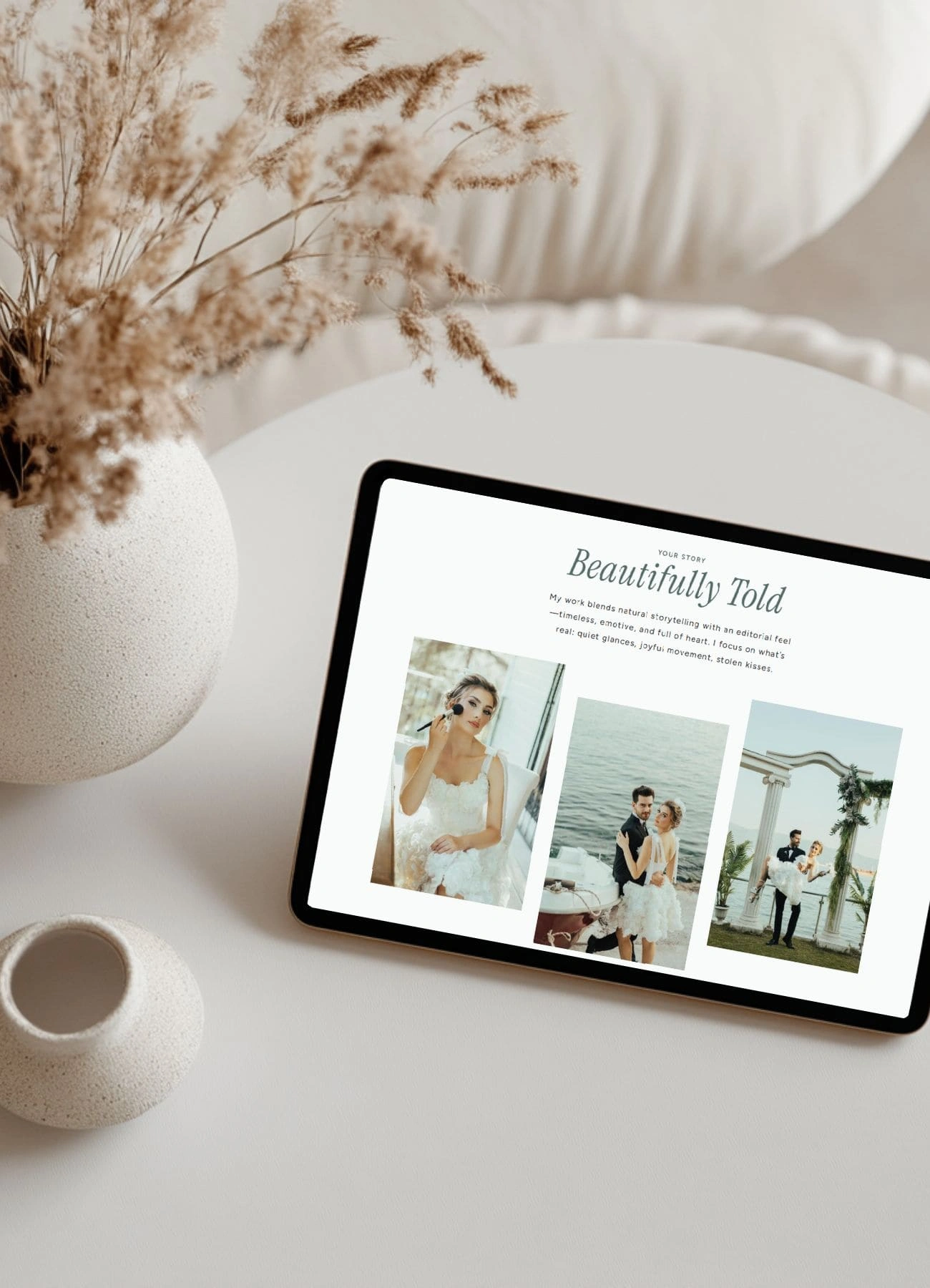
If you’re a wedding planner, you probably already know that your work is all about weaving together dreams, logistics, and a whole lot of personality into one beautiful, seamless day.
You’re a creative powerhouse, a masterful problem-solver, and a secret-weapon stylist, but does your website truly capture that magic?
As a web designer I love to see a planner’s online space reflect their incredible talent because your website shouldn’t just be a boring digital business card. When you get it right, it’s your virtual showroom, your best salesperson, and the ultimate first impression.
Your Website is Your Design Mood Board
Your site is like a massive, immersive mood board for your entire business. A couple should land on your homepage and immediately feel the style and energy of the weddings you plan. This goes way beyond just a few nice photos. It’s about the entire experience.
Color, Font, and Texture: The Foundation of Your Vibe
The first way to show off your creativity is through the foundational design elements.
Move Beyond Generic Colors
Are you known for high-end, classic elegance? Use a sophisticated, limited palette of neutrals and deep accents, with lots of clean white space. Is your vibe more “wild and romantic”? Incorporate earthy tones, unexpected textures, and maybe a pop of vibrant color.
Most website builders let you use custom fonts and colors easily across the entire site, so ditch the basic black and white if it doesn’t fit your brand.
Fonts as Personality
Your typography speaks volumes. A delicate serif font says “fine art and tradition,” while a bold, modern sans-serif suggests a contemporary, editorial style.
Don’t be afraid to pair two different fonts together. A strong heading font and an easy-to-read body font create visual interest and personality. This is a simple but powerful creative choice.
Subtle Textures and Elements
Think about incorporating subtle design elements that match your style. Maybe it’s a paper texture in the background of a section, a hand-drawn illustration icon, or a unique scroll-reveal animation that feels luxurious. These small touches are pure creativity in action.
Curate an Editorial Portfolio That Tells a Story
For a wedding planner, your portfolio isn’t just a gallery of pretty pictures; it’s a showcase of your process and vision. A creative portfolio is a curated experience that walks a potential client through the transformation you manage.
The ‘Case Study’ Approach to Show Your Creative Process
Instead of just showing the final result, show how you got there.
Beyond the “Final Shot”: Couples want to see how you turn an empty space into a breathtaking scene. Instead of just five photos of the reception, dedicate a portfolio page to a specific event and break it down.
Visual Storytelling: Use a mix of photos to tell the full story: the initial mood board, a close-up of a stunning detail (like the custom place settings or a floral installation), a wide shot of the ceremony and reception, and even a candid photo of you working behind the scenes.
Creative Captions and Details: This is where your planner brain shines. Don’t just caption a photo “Table Setting.” Try: “Bringing a Celestial Vibe to the Ballroom: Custom navy linens and gold foil-stamped menus elevated the atmosphere for this late-fall wedding.” Use descriptive, creative language that highlights your unique role and vision.
Mix Up Your Portfolio Presentation
Try to get away from boring square grids if your website software allows for that. If you’re using Showit (as I do), you have a lot of flexibility.
Interactive Galleries: Use a sliding or collapsing gallery feature to display multiple photos in one compact, elegant space. This keeps the page clean while still offering lots of beautiful imagery.
Asymmetrical Layouts: Ditch the standard three-column grid. Use a dynamic, asymmetrical layout where images overlap, are different sizes, or are placed in an unexpected pattern. This immediately gives your site a high-end, editorial feel that screams “designer.”
Tell Your Own Story with Intention
Couples hire a wedding planner because they want a partnership, not just a service provider. Your “About” page is the single best place to show your creativity by being authentic and making a connection. Your personal flair is a huge part of your creative signature!
Let Your Why Shine
Every creative has a driving force. Why do you plan weddings?
The Planner Persona: Are you the “organized-but-eccentric” planner? The “calm-under-pressure-luxury” specialist? The “moody-and-modern” visionary? Use your website copy and imagery to build this persona.
The Origin Story: Instead of a dry paragraph about your years in business, tell the story of the first time you planned an event that made you realize this was your calling. Use that narrative to frame your creative approach. Did you hand-dye 50 feet of silk ribbon for a client? Did you solve a catering crisis with a stroke of genius? Share it!
Visuals of YOU in Action
Don’t hide behind photos of weddings only. Your clients are hiring you.
Behind-the-Scenes Vibe: Include high-quality photos of yourself, but not just stiff headshots. Show yourself laughing, adjusting a centerpiece, sketching a floor plan, or interacting with a vendor. This shows you as the engaged, creative professional you are.
“My Favorite Things” Canvas: Use a small, fun section on your About page to list a few personal interests. What inspires you? A travel destination? A book? A type of art? This is a little window into your creative soul that makes you instantly more relatable and memorable.
Creative Ways to Use Your Blog and Services Pages
Many planners treat their Services page as a price list and their Blog as an afterthought. This is a huge missed opportunity to show your creative expertise! Your blog is your thought leadership platform, and your services page is a curated menu of amazing experiences.
The Education-Meets-Inspiration Blog
Your blog content should be a mix of helpful advice and pure creative inspiration, all styled beautifully on the page.
Creative Content Ideas
“What If” Scenarios: Blog posts like “What If We Combined Gothic Architecture with Tropical Florals?” show your boundary-pushing creativity.
Planner’s Pick: Curate your favorite inspiration. “5 Color Palettes We’re Obsessed with for next year.” Use high-end imagery and articulate why you love them.
Vendor Deep Dives: Showcase your creative network by interviewing a florist or stationer and discussing the art of their craft. This aligns you with other industry creatives.
Blog Design: Design your blog template to be visually stunning. Use large, immersive images, custom-designed graphic headers, and plenty of white space. Remember, if your blog posts don’t look good, people won’t stick around to read your great advice!
Present Your Services Creatively
Your services page should sell the feeling of being your client, not just the checklist of tasks.
Name Your Offerings Creatively: Move beyond “Full Service” and “Day Of.” Use evocative, branded names that suggest the experience, like “The Bespoke Vision,” “The Signature Celebration,” or “The Destination Dream.”
Visual Icons and Design: Use custom, branded icons to represent what’s included in each package. A delicate pen nib for “custom stationery coordination,” a champagne glass for “vendor management,” or a geometric shape for “floorplan design.” It’s a creative way to convey information instantly.
Interactive Elements: If you’re using Showit, use canvas views to create a toggle switch or an accordion-style drop-down where clients can click to reveal more details about a specific service. This keeps the page from feeling overwhelmed with text while inviting the user to explore.
Don’t Forget the Details: Micro-Creativity
In web design, just like in wedding planning, the small details are what separate the good from the truly exceptional.
Custom Hover Effects: Set elements to change color or slightly animate when a user hovers over them for subtle creative moments.
Seamless Mobile Design: Over half of people browse on their phones. Your creative design has to translate perfectly to a smaller screen. If you can choose a platform like Showit that lets you design your mobile view separately, so you can ensure the layout, fonts, and images look just as stunning and easy-to-use on the go.
Unique Call-to-Action (CTA) Language: The button that tells people what to do next. Instead of “Contact Me,” try “Let’s Design Your Day,” “Unveil the Experience,” or “Inquire to Begin the Magic.” Match the action to your brand’s creative voice.
Build Creativity into Your Site!
Your website is the single most powerful tool you have to communicate your vision, style, and professionalism before you even speak to a potential client. You are a highly creative professional, so make sure your online home reflects that to the max.
By focusing on curated visuals, authentic storytelling, and those luxurious little details, you’ll not only show your creativity but also attract the clients who are desperately searching for your unique kind of magic.
We work with and recommend the Showit platform, which is built for creatives. It’s not just another drag-and-drop builder; it gives us the freedom to create a deeply personalized, highly visual, and totally one-of-a-kind experience. It’s the perfect place to let your unique brand of planning genius shine.
If you’re ready to stop blending in and start standing out, it’s worth a look at the power and flexibility Showit offers for stunning layouts and tailored mobile design. And if doing it yourself is not for you, we’d love to help.
We offer a service for every budget, from stunning templates with optional done-for-you customization to a completely bespoke design, and we’d love to chat about helping you bring out your creative side on your site so you can attract the couples who are absolutely perfect for you.
FAQ
What makes a wedding planner’s website stand out?
A wedding planner’s website stands out when it reflects their unique style through cohesive branding, curated visuals, authentic storytelling, and a creative portfolio. Instead of blending in with generic templates, focus on custom fonts, elegant color palettes, and engaging layouts that showcase your process and personality.
How can wedding planners attract luxury clients with their website?
Luxury clients are drawn to wedding planners whose websites feel polished, editorial, and intentional. Use high-quality imagery, refined design elements, and storytelling that highlights your expertise. Show your creative process through case studies and position your services as tailored experiences rather than generic packages.
Why is portfolio design important for wedding planners?
A portfolio is more than just pretty pictures. It tells the story of your creative process. Couples want to see how you transform spaces, manage details, and bring visions to life. Including behind-the-scenes photos, detailed captions, and varied layouts creates a portfolio that feels editorial and compelling.
What should wedding planners include on their About page?
The About page should highlight your personality, creative story, and unique approach. Share your “why,” include authentic photos of yourself in action, and give clients a glimpse into your inspirations. This builds trust and makes your brand more memorable than a generic bio.

Jan Small is a web and graphic designer and owner of The Bonnie Pixel Design Co which offers all kinds of designs tailored for busy wedding professionals. Jan lives in Scotland with hubby and fur baby cockapoo Alfie and loves writing, yoga, and chocolate.


Leave a comment