
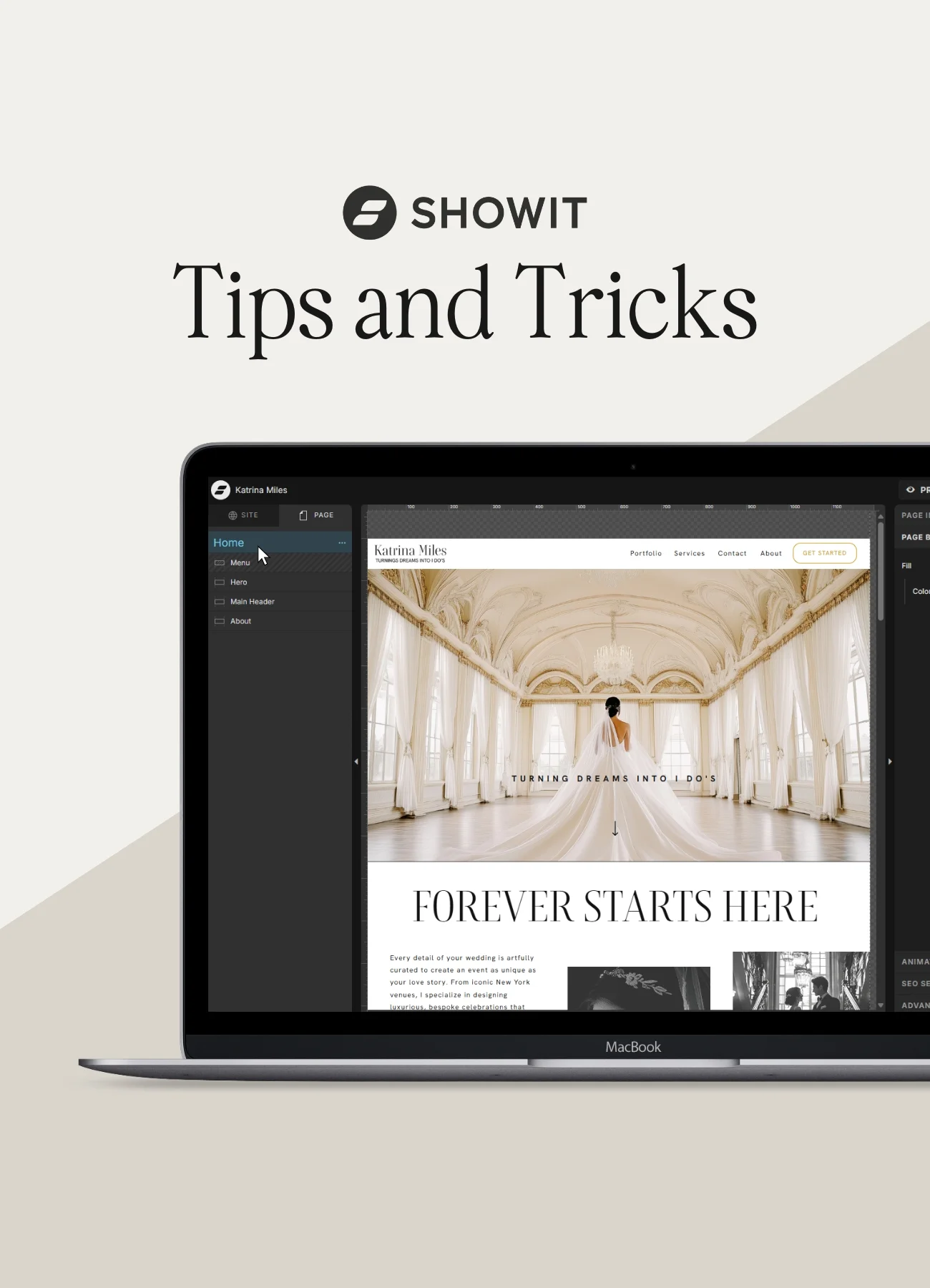
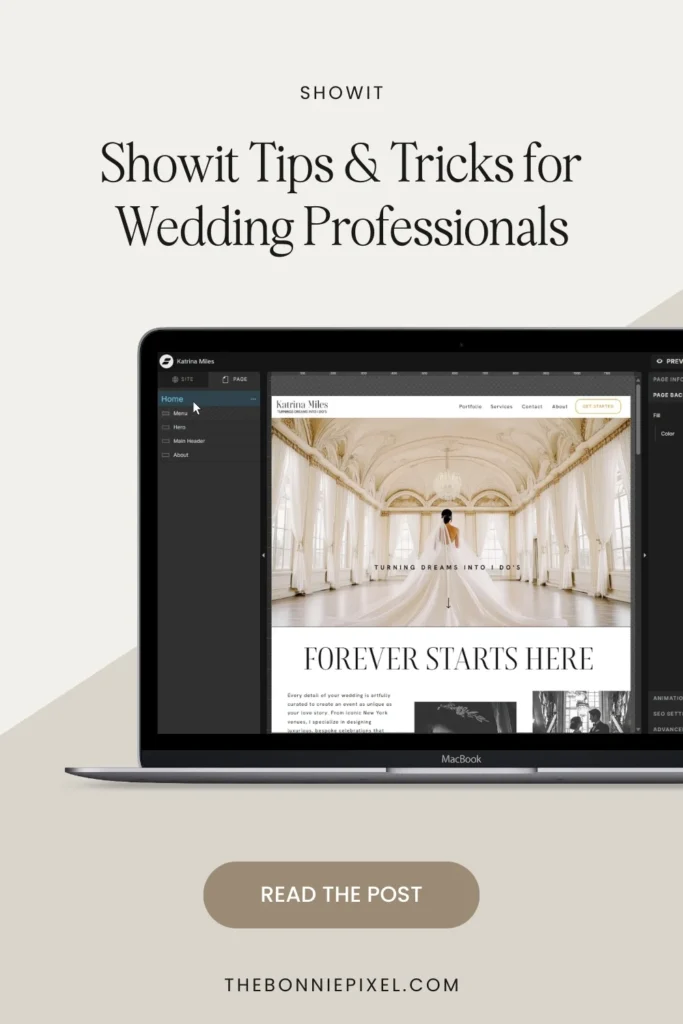
Showit has become one of the most popular website platforms in the wedding industry for a reason. Its drag-and-drop design feature and creative flexibility appeal to visually driven brands who want more freedom than standard templates allow.
For wedding professionals, Showit offers:
- Full design control without needing code
- Mobile and desktop layouts designed separately
- Integration with WordPress for blogging
- Flexibility for highly visual portfolios
- Creative freedom for custom brand expression
But while it’s easy to build something pretty, building something strategic requires so much more.
Here are 15 best practices to keep in mind when building your Showit website, so you end up with the best possible site.
1. Start With Strategy, Not Just Design
One of the biggest mistakes wedding professionals make is diving straight into design before thinking about strategy. Your site shouldn’t just be beautiful. It should guide your visitor naturally from curiosity to inquiry.
Before opening Showit, ask yourself:
- Who is my ideal client?
- What do I want them to feel when they visit my site?
- What action do I want them to take?
- What type of weddings do I want more of?
Your answers should influence the kind of layout, messaging, imagery, and navigation flow you design.
2. Design Desktop and Mobile With Equal Care
One of Showit’s most powerful features is that mobile and desktop are designed separately. But this can also be a trap if you only focus on one.
Many wedding professionals perfect their desktop site and neglect mobile. Considering most couples browse on their phones, this is a critical error.
If your mobile design feels messy, overwhelming, or slow, you’re losing potential inquiries, no matter how stunning the desktop version looks.
Consider these best practices when designing a Showit website for mobile:
- Simplify layouts instead of just shrinking them
- Stack content logically for scrolling
- Use larger text for readability
- Keep buttons thumb-friendly
- Reduce excessive animations
Think of mobile not as a “smaller version” of your desktop site but as its own experience.
3. Use Consistent Brand Styling Across Every Page
Showit makes it easy to get creative, but too much visual experimentation can hurt consistency.
For a professional look, it is important to maintain consistency in all aspects of your design, including font styles and hierarchy, color palette, button design, image treatment, and spacing between sections.
When every page feels visually connected, your brand feels professional, thoughtful, and premium.
For wedding professionals, especially, consistency builds trust. You want couples to feel like your brand is solid, calm, and reliable, not visually chaotic.
4. Create Clear, Simple Navigation
Your navigation should be intuitive, not clever. Couples don’t want to decipher where things are. They want to find what they need quickly, smoothly, and without friction.
An effective top-level navigation for your website usually includes:
- Home
- About
- Portfolio or Gallery
- Services or Collections
- Blog
- Contact
Avoid overwhelming visitors with too many menu items or odd labels that make them guess what’s behind each link.
Clean navigation is one of the most underrated website best practices and one of the most powerful for conversion.
5. Structure Your Homepage Like a Story
Your homepage is not just an introduction. It’s a journey. Your homepage should be like a narrative that gently guides your reader through who you serve, what you offer, who you are, why you’re different, and how they can work with you.
Rather than dumping everything on one screen, let your homepage unfold in sections:
- A strong hero section with emotional impact
- A brief positioning statement
- A featured portfolio or work showcase
- A short approach section
- A service overview
- A call to action
- Social proof (testimonials)
This structure mirrors the natural decision-making process your ideal clients go through and Showit makes these features easy to add.
6. Optimize Images Without Losing Quality
High-quality imagery is essential for wedding professionals, but oversized images can slow down your site.
You need to balance quality with size in your optimization process so that images are:
- Large enough for visual impact
- Small enough for fast loading
- Saved in the correct file format (JPEG or WEBP for photos, PNG for graphics)
- Consistent image dimensions
Slow loading times lead to higher bounce rates (lost clients!), especially on mobile connections.
Your visuals should feel luxurious without slowing down the user experience.
7. Use Showit Site Styles for Brand Consistency
Showit’s Site Styles feature allows you to create a library of consistent text and button styles across your website.
This is one of the most useful tools for long-term site management.
With Site Styles, you can:
- Control your heading styles
- Set standard paragraph formatting
- Keep button designs uniform
- Update entire styles across your site instantly
This makes future updates faster and prevents small inconsistencies from creeping in over time.
8. Design With White Space and Restraint
Wedding professionals often feel tempted to show everything with more photos, more galleries, and more text.
But restraint is a sign of luxury.
One of the most elegant Showit website best practices is the generous use of white space.
Being intentional with your choice of images and website copy allows your imagery to breathe and your message to feel more intentional and easy to read. Good use of white space can result in a website that feels calm instead of cluttered and a brand that feels more premium.
Minimal doesn’t mean lacking. It means making room for meaning, emotion, and impact.
9. Make Your Calls to Action Clear and Natural
Every page should have a purpose. What do you want your visitor to do next?
Website best practices include placing clear, intentional calls to action throughout your site, such as:
- “View My Work”
- “Explore My Services”
- “Start Your Enquiry”
- “Get in Touch”
Avoid making CTAs overly salesy or pushy. In the wedding industry, elegance always outperforms urgency.
Simple calls to action work far better than aggressive selling.
10. Tell Stories With Your Portfolio
Don’t just upload galleries full of photographs from every wedding. Curate them.
Wedding clients don’t just want to see beautiful photos. They want to see experiences, emotions, and real stories.
Best practices for portfolios include:
- Grouping work by wedding or project
- Adding short descriptions or context
- Highlighting your role and approach
- Choosing your strongest images, not all of them
Show less, but better.
This positions you as curated, refined, and intentional: qualities that attract higher-end clients.
11. Use Your About Page to Build Emotional Connection
Your about page isn’t a CV. It’s the page where your future clients decide if they feel aligned with you.
Your about page is an opportunity to share your story, communicate your values, and explain your approach. Done well, your about page should build trust through reflecting your personality and helping clients feel understood.
All this is important because in the wedding industry, especially, people don’t just book a service; they choose a relationship.
12. Make Your Services Page Clear, Confident, and Structured
A confusing services page is one of the biggest conversion blockers.
Your services page should:
- Clearly explain what you offer
- Who it’s for
- What makes it different
- What the process looks like
- What to do next
And while you don’t need to list exact pricing, you should give strong guidance around your pricing level and positioning if you don’t.
13. Integrate Your Blog Strategically
Because Showit integrates with WordPress, your blog can become a powerful SEO and branding tool.
But only if it’s used intentionally.
Because Showit integrates with WordPress, it becomes easy to apply important strategies, such as:
- Using categories relevant to your services
- Optimising posts for relevant keywords
- Linking to your portfolio and services
- Adding SEO optimized visuals to your blog posts
- Maintaining consistent styling
Your blog can help position you as an expert while also driving organic traffic to your site.
14. Use Templates Strategically, Not Lazily
Showit templates are a fantastic starting point for your website, but they should not be your final look if you want to stand out from the crowd.
To avoid having a website that looks generic or common, follow these recommended guidelines when designing your Showit website. Always:
- Customize colors and fonts to your brand
- Replace all stock images with curated images that reflect your style and brand
- Adjust layouts for your content
- Rework sections to support your goals
- Add copy that speaks to your ideal client and ensure all placeholder text is removed.
This ensures your site feels bespoke, not generic.
In a creative industry like weddings, originality is everything.
15. Regularly Review and Refresh Your Site
Your website isn’t a “set and forget” tool. Review and refresh your site regularly by:
- Updating galleries with your latest work
- Refreshing testimonials
- Tweaking copy as your messaging evolves
- Improving layouts based on feedback and analytics
This keeps your site aligned with your growth and your current brand level.
Showit’s drag-and-drop and visual editing features make it easy to update your site without technical knowledge or having to hire a designer. You can use the handy Preview feature to make sure you’re happy with your edits before you hit “Publish.”
Combining Showit With Best Practices for Website Design
Showit is not just a design tool; it’s a canvas. But what you create on it determines how potential clients experience your brand.
When you follow thoughtful design practices, your site becomes:
- A visual representation of your expertise
- A natural filter for your ideal clients
- A powerful conversion tool
- A reflection of your confidence and positioning
For wedding professionals, where emotion, trust, and beauty all play vital roles, your website should feel like an extension of the experience you provide in real life.
Not just something pretty to look at, but something that makes the right couples feel at home.
If you’re ready to elevate your online presence, our Showit website design services are built around creating beautiful, strategic websites for wedding professionals who want to attract the right clients and feel truly confident sharing their site. You can find out more about our services here.

Jan Small is a web and graphic designer and owner of The Bonnie Pixel Design Co which offers all kinds of designs tailored for busy wedding professionals. Jan lives in Scotland with hubby and fur baby cockapoo Alfie and loves writing, yoga, and chocolate.


Leave a comment